How to Format Like A Pro!
- Courtney Murphy
- Jul 19, 2024
- 4 min read

Updated: Jul 22, 2024
Now that you’ve selected a template, the next step is formatting your résumé. As mentioned, there are three kinds of formatting: chronological, functional, and combination. Our primary focus is on the chronological style, where we highlight your experience. As students and first-time résumé writers, the sections you should include are contact information, relevant/work experience, skills, and education. Almost all résumés have these sections.
You can add other sections if necessary such as volunteer work, activities, summary, awards/publications, relevant coursework, or projects. These are components to help fill space but they are not required. We’ll break down each section and showcase where it can go on your résumé.
1. Contact Information
Contact information is a must section of your résumé, it should be one of the first things you write aside from your name. This section should always be at the top. It doesn’t have to necessarily be in its unique section with a header. It can be under your name as a line. You should include an email, phone number, and location in (city, state) format. Other things to list could be social media handles or websites and portfolios.
Courtney Murphy
123-4556-7890 | professional@email.com | location (city, state)
Website: insert link here | Instagram: username | Facebook: Username
2. Experience
Experience is the most vital section of your résumé. It shows the hiring manager what you’ve done in school and the workforce. Depending on if you have a one or two-column résumé, you can move the experience section around a bit. If you’re a junior or below, you may want to put experience under education. If you’re a senior or higher, education can be moved to the bottom. However, this rule for seniors is not required but is highly encouraged
Experience can be divided into two sections: relevant or work experience. Relevant experience is any job or internship that is professional and related to your major. Work experience is any part-time gigs that aren’t as relevant to your major. Relevant experience is the section you want to highlight more. If you have more work experience than relevant experience, that’s fine. But the goal is to continue to build that up!
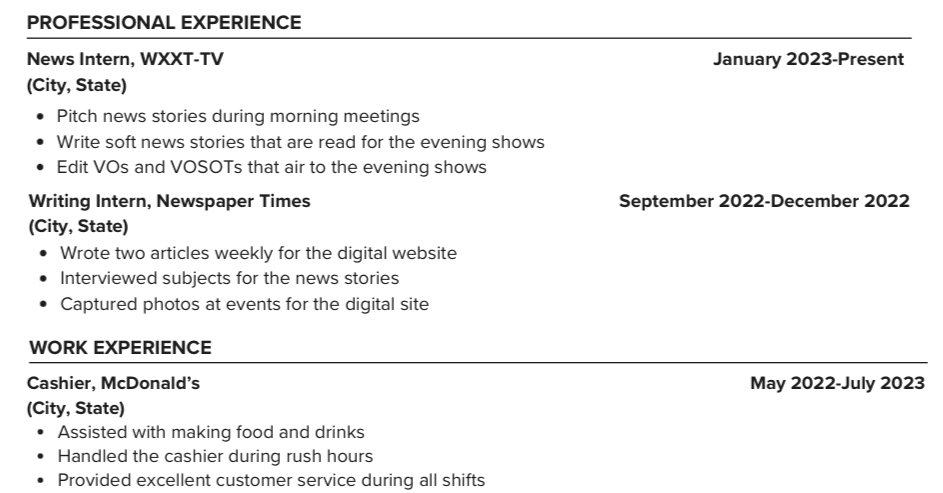
You want your experience to be listed in reverse chronological meaning from most recent on top to least recent on the bottom. When crafting your experience, think about any work you’ve done that’s related to your major or part-time gigs. Be mindful, that sophomore grades and higher should avoid placing any experience from high school. All jobs should be marked with the company name, job title, dates (month year), and location (city, state).
Following that should be three to four bullet points explaining your responsibilities. That should not be a copy-pasting of the job descriptions. Start with an action verb for each bullet point detailing responsibilities and accomplishments.
3. Education
Education shows where you received any degree from a university or college. That can go on the top for junior classes and below or the bottom if you’re a senior. It should have the institution name, school name, degree, graduation, or anticipated date and location. Then, if necessary, you can include minors, GPA, or relevant coursework. Only include a GPA if it’s above 3.5.
Relevant coursework is any courses you took that are relevant to your degree. These do not require any description, but there should only be a limit of six courses.

4. Skills
This section showcases your technical skills in software, computer programs, languages, or social media that you are proficient in. If someone asks you if you could use a certain program and you’ve never heard of it or couldn’t figure it out when you had to use it for a class, then don’t put that skill on your résumé. If you received a test on a skill and felt you could ace it, then place it on your résumé. Skills should not include any character traits, adjectives, or qualities. For example, words like "communication," "creativity," or "engaged learner" are not things that you could get tested on.
5. Volunteer
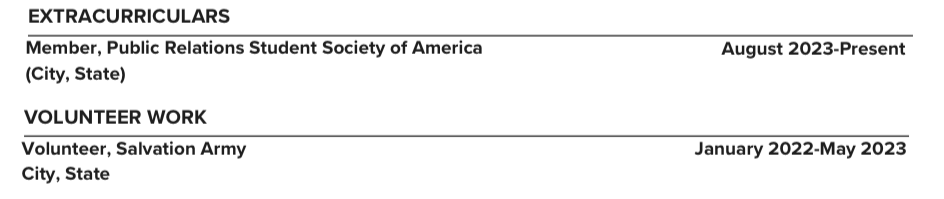
Volunteer work is just work you’ve done giving back to the community. Here descriptions are optional. You can list it with the company name, title, dates, and location.
6. Activities
Activities in the section are somewhat of a catch-all. These can be any clubs, social groups, sororities, and fraternities where you’re a member but don’t have a significant role. It has the same formatting as others where you can list the organization name, title, dates, and location. Like the "Volunteer Work" section descriptions are optional.
7. Awards/Publications
This section mentions any awards and publications that you’ve earned or published. This section can go near education, in its own section, or even within your experience section. This section should include the award name and date. For publications, include the site, article title, and the date it was published. Descriptions for this section are not required.
8. Summary/Objective
This is a section where there’s a divide in recruiters, some people want them, some don’t. However, if you have a terrible objective, it can tarnish your résumé. This section should be at the top of your résumé, so above experience and below contact usually. This should be up to four sentences describing your experience and what you bring. You can highlight any skills, professional achievements, and character traits.
Ex: Motivated freshman journalism student seeking an internship in a newsroom environment. Experienced with producing and executing news stories within tight deadlines.
Watch our video here:
Follow us on LinkedIn


Comments